

Canada Consumer Behaviour Insights: Online Shopping, Inflation, and Retail Trends

Contents
Understanding how Canadians are shopping, spending, and making decisions is essential for navigating today’s retail and economic landscape. Our consumer behaviour data from Echo Intelligence highlights key trends in online shopping behaviour, shifts in spending across major retail categories, the impact of inflation on purchasing choices, and the growing importance of environmental values.
These findings offer a clear view of how Canadians are engaging with brands right now—revealing what matters to them, how their priorities are evolving, and where opportunities are emerging for marketers and retailers.
Online vs in-store shopping
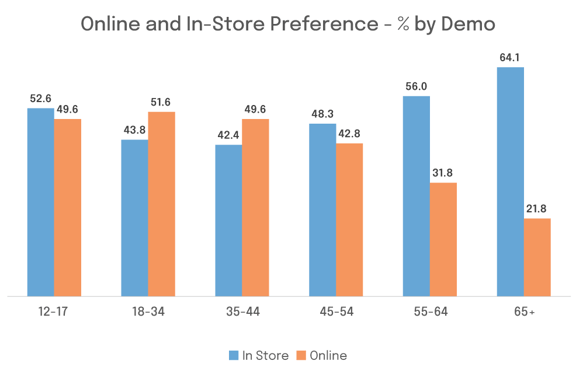
More than half of Canadians aged 12+ (51%) still prefer shopping in-store, though online shopping is catching up—now at 40%, up from 34% in 2024. Households with higher incomes are showing greater enthusiasm for shopping online, with 44% favouring it, while 52% of lower-income households continue to lean towards in-store purchases.
Shopping preferences vary noticeably by age group. Teens, who often lack access to credit cards, overwhelmingly favour shopping in-store. In contrast, adults 18–34 are the most active online shoppers, leading all other age cohorts in their use of digital retail. As age increases, there’s a steady decline in preference for online shopping, with older Canadians continuing to choose in-store shopping as their primary method.
As for regional preferences, Atlantic Canadians are the most enthusiastic about online shopping, with 43.4% favouring it, whereas Quebecers are leading the way in in-store shopping, with 52.5% preferring to shop in person.
NLogic Echo Intelligence – Age 12+ Canada Fall 2025 – National
Category Insights
Who Visits Cannabis, Outlet, and Health Food Stores by Age and Gender
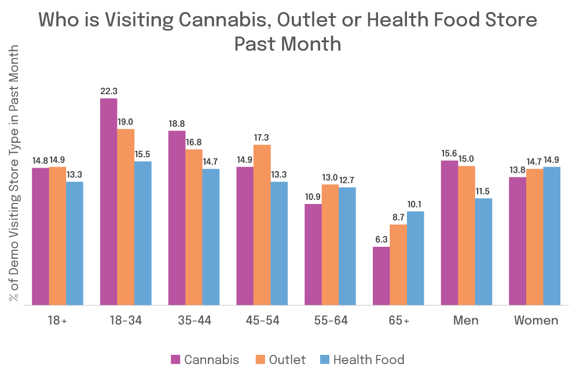
Echo Intelligence provides a clearer picture of how store preferences differ across demographic groups, highlighting patterns in visits to cannabis retailers, outlet centres, and health food stores. Looking at our 2025 survey, we can see that:
- Weekly visits to these three retail categories sit at approximately 13–15% among adults aged 18+.
- Outlet stores are most popular among younger adults, with 19% reporting visits. Adults aged 45–54 follow closely, with 17.3% reporting visits.
- Men are slightly more likely than women to report visiting outlet stores (15.0% vs. 14.7%). These figures reflect whether respondents visited at least once; visit frequency is not accounted for.
- Health food stores are especially popular among adults aged 18–34. Visit rates for this group are 15.5%, compared to the overall adult average of 13.3%.
- Women are more likely than men to report visiting health food stores at least once a month.
- Cannabis shops are most appealing to adults aged 18–34, with 22.3% reporting visits.
NLogic Echo Intelligence – Age 18+ Canada Fall 2025 – National
Who Participates in Online Betting by Age and Gender
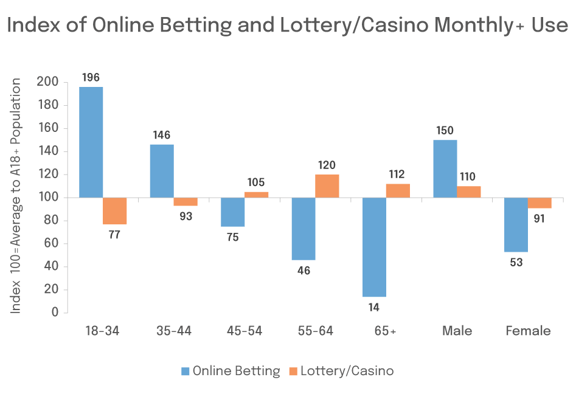
Awareness of online betting is high among Canadian audiences, particularly among sports viewers, while news viewers are more likely to be aware of lottery and casino gaming. Despite this awareness, participation differs sharply between online betting and in‑person lottery and casino activities and varies significantly by age.
- Overall participation
- Only 5.4% of Canadians report betting online monthly.
- By contrast, 49.1% report playing lotteries or visiting physical casinos, indicating far broader participation in non‑online gambling formats.
- Online betting participation by age
- Young adults are nearly twice as likely than average to bet online.
- Online betting participation declines steadily with age.
- Adults aged 65+ are 86% less likely than average to bet online.
- Lottery and casino participation by age
- Young adults are the least likely to participate in lottery or casino gaming.
- Participation skews older, with adults 55 and over more likely than average to engage
NLogic Echo Intelligence – Age 18+ Canada Fall 2025 – National
Online Buying and Selling Participation by Age
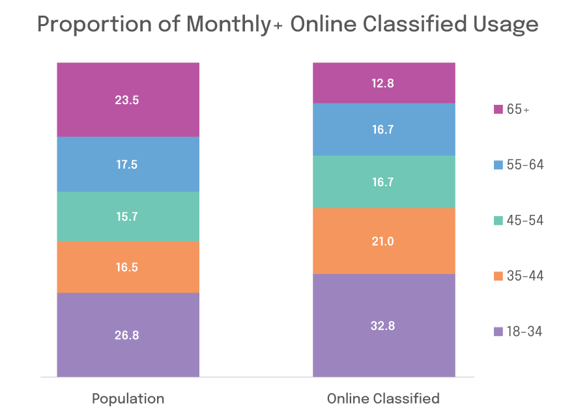
Buying and selling goods online is well‑established, but participation levels vary by age when compared to the overall population. Engagement skews heavily toward younger adults, while older demographics participate less frequently, despite gradual increases in adoption.
- Younger adults are more active in online buying and selling than the general population, with participation that outpaces their share of the population.
- While participation for older adults remains lower, adoption continues to increase gradually over time.
NLogic Echo Intelligence – Age 18+ Canada Fall 2025 – National
Grocery Spending Patterns by Household Size
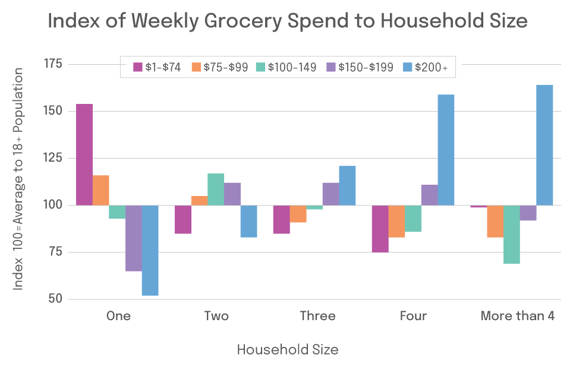
Many categories in Echo Intelligence capture not only participation, but also frequency of use, spending levels, and demographic context. Grocery spending, in particular, varies not only by household income but also by household size, which is a relevant lens for media planning given the near‑universal participation in grocery shopping among adults.
- Single‑person households are significantly more likely than the overall 18+ population to spend $75 or less per week on groceries.
- Not surprisingly, as household size increases, the likelihood of higher weekly grocery spending rises.
NLogic Echo Intelligence – Age 18+ Canada Fall 2025 – National
Psychographic-Value Statements
Understanding how consumers feel about current issues can help guide communication strategies and advertising decisions. Echo Intelligence includes a range of questions about consumers’ attitudes as they move through the buying process.
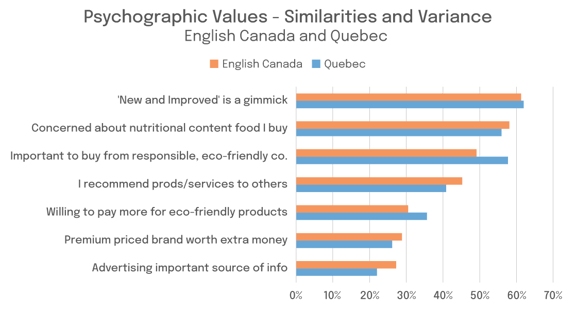
While the data can be broken down by product category and usage, this example focuses on comparing attitudes in Quebec with those in the nine English speaking provinces.
- Over 60% of respondents agree that “‘new and improved’ is just a gimmick”.
- In Quebec 22.0% agree/strongly agree with "Advertising is an important source of information" with over 27% in English Canada believing it.
- The “Important to buy from responsible, ecologically-friendly companies” responses vary significantly between communities. In Quebec 57.7% agree or strongly agree with the statement, but in English Canada only 49.1% agree or strongly agree.
- A similar division occurs with the willingness to pay more for eco-friendly products. 30.5% of English Canada agrees or strongly agrees with the statement while almost 36% of Quebec does.
All percentages shown reflect adults who either agree or strongly agree with the statements.
NLogic Echo Intelligence – Age 18+ Canada Fall 2025 – National
With Echo Intelligence, you’re not just keeping pace—you’re setting the standard. Our actionable insights uncover what truly matters to Canadian consumers, empowering you to forge stronger connections and ignite new possibilities. As the market transforms, Echo Intelligence is your catalyst for innovation and growth, providing the vision and assurance to stay ahead of every curve.
Contact us today to learn how you can access Echo Intelligence, your blueprint to modern Canadian life.
From July 11 – August 29, 2025, NLogic Canada conducted an online survey of 37,843 Canadians aged 12+, led by Sago, as part of its Echo Intelligence research. The survey was weighted against benchmarks from 2021 Canadian census. Weighting was performed using raking (IPF: Iterative Proportional Fitting) within geographies, with post-stratification to population totals. Missing data was corrected through imputation. To minimize order effects and reduce respondent fatigue, question blocks were randomly assigned using Randomization method. As this study was conducted using a non‑probability sample, a formal margin of sampling error cannot be calculated. For comparison purposes only, a probability sample of 37,843 yields a margin of error no greater than +/- 0.5% (19 times out of 20). As with all survey research, estimates for population subgroups are subject to greater variability, with smaller sample sizes producing wider confidence intervals.